Introduction
Extending your home is exciting. More space, more light, a layout that finally works for family life – and the value uplift that usually follows. Yet for all the promise, the path to a successful home extension is shaped by one decision more than any other: who builds it.
The right builder turns well-drawn plans into a stress-free, high-quality reality. The wrong builder turns dreams into delays, disputes, and cost overruns.
This guide explains, in practical terms, how to choose a UK house extension builder with confidence. It sets out the mistakes to avoid with building an extension, the positive signs to look for, and how experienced providers of architectural services fit into the process to reduce risk and smooth the journey.
You will find checklists you can act on today, questions to ask, and a step-by-step method to compare builders fairly. This guide applies wherever you are in the UK, and it reflects the way we work with our clients across Canterbury, Whitstable, Herne Bay, and the wider Kent area, where clear drawings, realistic specifications and local knowledge make all the difference.
If you take only three things from this page, let them be these:
First, do not choose on price alone.
Second, verify experience specifically in house extensions and in homes like yours.
Third, involve experienced architectural services from the outset so builders are quoting the same thing and building to a coherent, compliant design.
Why choosing the right builder matters
House extensions are complex, lived-in projects
Extensions are not mini new-builds. They involve:
- Opening up and tying into an existing structure
- Managing temporary support
- Protecting occupied rooms
- Coordinating multiple trades in tight spaces
- Sequencing works so your life can continue around them.
- That complexity makes experience invaluable.
The financial stakes are real
Even modest single-storey additions often exceed £50,000 once foundations, structure, finishes and professional fees are included. Larger or two-storey schemes cost more.
A poor builder selection can add tens of thousands through variations, rework and lost time. A careful selection routinely saves more than it costs to do properly.
Good vs bad outcomes in the real world
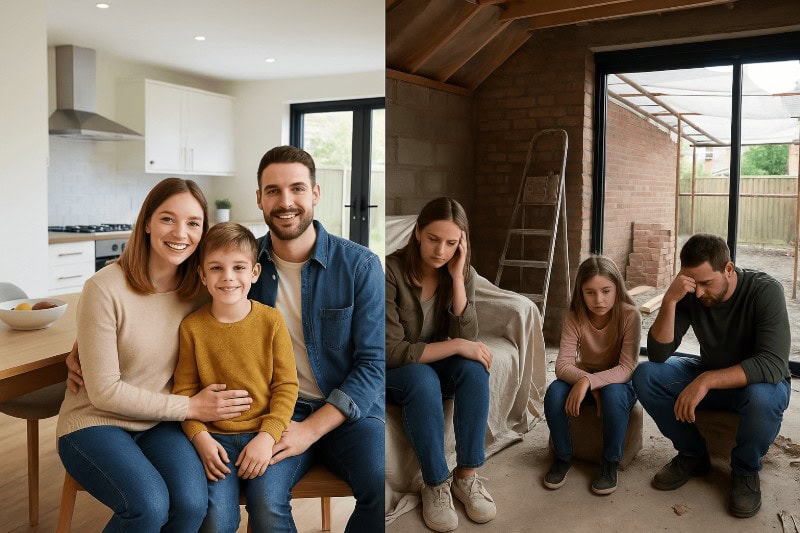
Two families in Whitstable planned rear house extensions of similar size.
Family 1
The first family accepted the cheapest quote.
The builder used vague allowances for kitchens and flooring, promised a 10-week programme, and wanted a large deposit. Three months later only foundations were complete.
Variations for steelwork and drainage appeared because the drawings were not detailed and the builder had not priced them.
The family spent more than the next two bids would have cost, and lived on a building site for six months longer than planned.
Family 2
The second family started with a detailed design and specification prepared by an experienced architectural services team.
They tendered to three builders with proven track records of building an extension for similar properties, met two past clients for each, and used a written homeowner contract with staged payments.
Their project finished within two weeks of the programme, the budget moved only where they chose to upgrade, and the finish quality matched the drawings. The difference was not luck; it was process.
Common mistakes people make when choosing builders
Rushing into the cheapest quote
Low bids can conceal missing scope or unrealistic allowances. If a price looks too good to be true, it usually is. Unfortunately, they’re also often quoted by cowboy builders.
Cheap quotes often exclude essential items like insulation upgrades, drainage diversions or structural steel connections. Those costs reappear later as variations.
Action to take: insist on an itemised quotation against a written scope and drawings. Ask the builder to confirm in writing that the price includes all structural steel, foundations, insulation to current standards, waste removal, making good and VAT.
Not checking references or past projects
A polished website proves little. You need to see build quality up close and speak to homeowners who lived through the process.
Action to take: request contact details for at least two recent extension clients and one from two or more years ago. Ask to visit one finished project and, if possible, one in progress.
Prepare five questions:
- How did communication work day-to-day?
- What happened when the unexpected cropped up?
- Were budgets honoured?
- How clean and respectful was the team?
- Would you use them again?
Failing to clarify what’s included and excluded
Ambiguity is the seedbed of disputes. Typical grey areas include kitchen fittings, flooring, decoration, provisional sums for groundwork, and allowance levels for sanitaryware.
Action to take: provide a written specification. If you do not have one, ask your architectural services provider to create it.
Demand that the builder lists specific exclusions and every provisional sum with a realistic allowance. Replace provisional sums with fixed prices where possible.
Assuming all builders understand extensions
A contractor who mostly builds garden walls or new homes may not excel at complex knock-throughs with steelwork and occupied houses.
Building an extension needs temporary works knowledge, dust control, and calm coordination.
Action to take: shortlist firms who show multiple completed extensions similar to yours. Ask about their approach to temporary support, dust management, and working in occupied homes.
Skipping checks on insurance, trading history and qualifications
Without the right insurance, you could be exposed if something goes wrong. A firm that has traded for five minutes may not be resilient enough to finish the job if cash flow tightens.
Actions to take:
- Ask for copies of public liability and employers’ liability insurance certificates and check expiry dates.
- Request confirmation of who holds the contract (sole trader, partnership or limited company).
- Verify the trading history and registered address.
- Ask who will be on site every day and the experience of the site lead.
Overlooking property-type experience
Victorian terraces, 1930s semis, post-war cavity wall homes and listed cottages all behave differently. Damp management, insulation upgrades and structural junctions vary.
Action to take: choose a builder who has worked on your era of property. Ask how they handle cold bridges at steel penetrations, damp in solid walls, or ventilation in tight loft voids.
Underestimating the importance of communication
A builder who updates you regularly and responds quickly de-stresses the process. One who avoids calls or gives vague answers increases anxiety and risk.
Action to take: before appointment, agree how updates will work. Many clients like a weekly on-site meeting, a simple written progress note, and photos of key stages. Specify this in the contract.
Positive qualities to look for in a builder
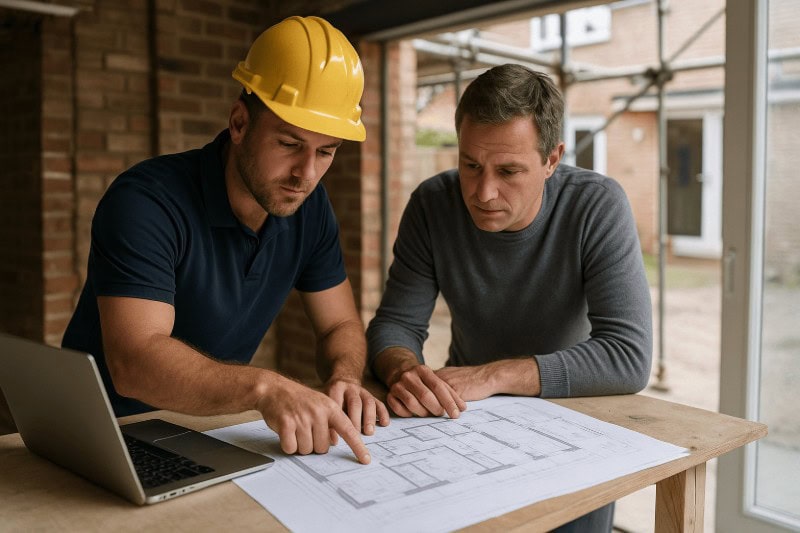
Transparency in quoting and costs
A good builder explains how numbers are built up – and is open about risk items. They will highlight areas where costs could move and suggest ways to manage them.
Action to take: ask for an itemised quotation that aligns with the drawings and specification, with rates for variations set out in advance. Request a draft programme with key milestones.
A strong, relevant portfolio
Finished extensions, not just structural shells, show attention to detail: consistent tiling lines, crisp plastering, straight reveals, and functioning drainage.
Action to take: when visiting completed work, look past the showpiece kitchen. Check corners, door margins, mastic lines, and the junction between new and old floors. Ask the homeowner what the builder did when a mistake occurred.
Calm, consistent communication
You are looking for a team that listens, explains and documents decisions. Professionalism in pre-contract stages tends to predict professionalism on site.
Action to take: note how promptly they reply, whether answers are specific, and whether they are happy to work alongside your architectural services team.
Experience with planning conditions and building regulations
A builder who is used to delivering to current standards will not grumble at correct insulation thicknesses, fire protection to steel, or proper ventilation routes.
Action to take: ask how they typically coordinate with building control and what information they expect from your designer in order to price accurately.
Memberships and accreditations
Memberships such as the Federation of Master Builders or TrustMark offer some assurance, as do manufacturer certifications for specific products. They are not guarantees, but they add weight.
Action to take: verify memberships and ask what practical standards or inspections they involve. For example, just because they say they are Master Builders doesn’t necessarily mean they are, so you should always check.
Proper insurances and sensible warranty options
Public liability, employers’ liability and, on larger projects, contractors’ all-risk cover, are essential. Post-completion, a clear defects liability period and access to insurance-backed warranty options for structural work are reassuring.
Action to take: ask how defects and snagging will be handled, how long the rectification period runs, and whether any warranty is insurance-backed.
Collaborative attitude with your architectural services provider
The most successful projects have clear drawings and a builder who respects them. The builder’s practical knowledge adds value; the design intent stays protected.
Action to take: ask the builder how they prefer to resolve clashes between site realities and drawings, and whether they will attend pre-start meetings with your designer to walk through details.
Reliable subcontractor and supplier relationships
Extensions stand or fall on the availability and quality of electricians, plumbers, plasterers, roofers and kitchen installers. Reliable teams keep the programme moving.
Action to take: ask who their regular subcontractors are and how long they have worked with them. Ask about lead times for key materials like windows and steels.
Understanding the role of architectural services
Why you need experienced design, not just a builder
An extension succeeds on paper before it succeeds on site. Clear floor plans, sections, structural details, window schedules and a written specification set the standard. Without them, builders fill gaps in different ways; quotes diverge; disputes later are almost inevitable.
Experienced providers of architectural services prepare buildable designs, anticipate tricky junctions, coordinate structure, drainage and insulation, and make sure planning drawings are turned into construction information that a builder can price and follow.
They also understand local council planning policies (in our case, in Kent, where a conservation area is often a consideration), saving time by avoiding designs that will never gain approval, and they liaise with building control to smooth compliance.
How design quality protects your budget
A detailed set of drawings and a specification reduces provisional sums and guesswork. When every outlet, tile, socket and lintel is defined, builders compete on execution rather than on how little they can include. You can then compare like-for-like and choose on value.
The benefit of ongoing involvement
Even if you do not want full project management, having your designer available during construction gives you a professional eye when decisions arise. A quick site visit to check a steel plate thickness, a lintel bearing or a damp-proof course can prevent expensive rework. Good builders welcome this collaboration; it de-risks their work, too.
Mistakes to avoid in choosing a designer
Avoid anyone who draws pretty pictures but cannot explain how the junctions work or what insulation thicknesses are required. Beware of designs that ignore buildability or assume unlimited budgets.
Prioritise designers who regularly produce building regulation packages and have strong contractor relationships.
Checking builder credentials properly
How to review previous work
Start online, but do not stop there. Social media helps you shortlist; real homes help you decide.
Action list:
- Ask for three extensions completed within the last two years and one older than two years.
- Visit at least one in person. Your potential builder should have a strong relationship and so facilitate that visit.
- Take a simple checklist: quality of plastering, alignment of tiles, evenness of floor levels, smoothness of paintwork, straightness of door margins, cleanliness of mastic lines, and how the new roof ties into the old.
- Ask the homeowner about aftercare and whether snagging was handled promptly.
What to ask past clients
Use open questions and listen for hesitation.
Questions to use:
- What went better than expected?
- What was harder than expected?
- How did the builder deal with unexpected findings, such as hidden drainage or weak existing foundations?
- How accurate was the original price, and why did it change?
- Would you use them again, and if not, why not?
Verifying trading history and stability
While small firms can be excellent, longevity and a stable core team are positive signs.
Action to take: verify how long the business has been trading and where it operates from. Confirm who will be contractually responsible for the work, and who will be your day-to-day contact. Ask what happens if the site lead falls ill or takes leave.
Avoiding fly-by-night operations
Red flags include changing trading names, reluctance to provide references, requests for large upfront payments, and pressure to decide quickly.
Action to take: slow the process down. Reputable builders expect diligence and will not rush you.
Understanding deposits and staged payments
For extensions, a modest deposit to secure a start date or order long-lead items can be sensible, but do not fund a builder’s business. Payments should follow progress.
Action to take: agree a staged payment schedule linked to milestones such as foundations, superstructure, roof complete and watertight, first fix complete, plastered, second fix complete, practical completion, and retention for defects. Make the schedule part of your contract.
Getting and comparing quotes
How many quotes do you need?
Three well-matched quotes are generally enough to show the market price. More than that and your project risks becoming a time-sink for everyone involved.
Action to take: tender only when your drawings and specification are ready. Brief each builder in the same way and give a fixed return date.
Ensuring like-for-like comparisons
Comparisons fail when the scope differs. You need to level the playing field.
Action to take: supply a single tender pack with drawings, structural information, specification, finishes schedule and a schedule of works. Ask for a priced schedule so you can compare line by line.
Understanding provisional sums and prime cost items
Provisional sums are placeholders for uncertain work. Prime cost items are allowances for client-selected items like sanitaryware and tiles. Both can grow.
Action to take: replace provisional sums with fixed prices where possible. If not possible, ensure allowances are realistic and the rate for additional work is agreed in advance.
Red flags in quotations
Beware of vague notes such as “assumes standard foundations” or “excludes making good”. Look carefully at sums that are too low to be realistic, and at missing items like scaffolding, waste removal, or making good decorations.
Action to take: return the quote with a clarification list. Ask the builder to confirm in writing whether each item is included and, if not, what it would cost to add.
Why the cheapest is rarely the best
A high-quality build costs what it costs. A significantly lower quote usually reflects omissions, underestimated labour, or a plan to reclaim margin via variations.
Action to take: if you like a lower-priced builder, ask them to walk the drawings with your designer and explain how they are achieving the price. Sensible savings can be explored transparently; magic is a warning sign.
Importance of written contracts and schedules
A clear, fair contract protects both sides. It sets out scope, price, payment stages, change control, programme, insurances, and dispute resolution. A programme, even if approximate, keeps everyone aligned.
Action to take: use a homeowner-friendly building contract. Attach the drawings, specification, quotation and payment schedule. Include agreed working hours, neighbour considerations and site rules.
Communication and project management
Why communication matters as much as technical skill
Problems rarely explode when they are spotted early and discussed openly. Communication prevents small issues from becoming large ones.
Action to take: set expectations up front:
- Agree a weekly progress meeting on site with notes shared by email
- Identify decisions needed in the next fortnight
- Keep a simple change log with cost and programme impact recorded as they arise.
Signs of a well-managed site
Organised sites deliver better results. Look for tidy materials storage, clear segregation between work and family space, protection of existing flooring, dust control measures, and labelled waste.
Action to take: before appointment, visit one of the builder’s live sites. If they are unwilling to show you, reconsider.
The benefit of builders working with a project lead
Having your architectural services provider available for key site meetings adds a layer of quality assurance. Builders gain quicker decisions and fewer callbacks; you gain confidence that the design intent is respected.
Action to take: schedule a pre-start meeting with you, your builder and your designer to walk through the drawings, highlight tricky junctions, and confirm responsibilities.
What to do if communication breaks down
Address it early. Restate expectations in writing, record decisions, and if needed, request a meeting with the site lead and company owner. If issues remain, refer to the contract’s dispute procedure.
Action to take: keep notes of conversations, save emails, and photograph areas of concern. Facts calm emotions.
Legal and compliance considerations
Planning permission and permitted development
Some extensions fall within permitted development; others need full planning permission. Conditions sometimes attach to approvals and must be followed. Your designer will confirm the correct route for your home and location, prepare the submission, and manage responses.
Action to take: never start structural work without confirming the planning permission status in writing. Keep decision notices and approved drawings on site.
Building regulations approval
All structural extensions require building regulations approval, covering structure, fire safety, insulation, ventilation, drainage, and more. Approval can be sought via a plans-first approach with detailed drawings, which most homeowners prefer for clarity.
Action to take: appoint your designer to prepare a building regulations package and liaise with the inspector. Ask your builder to notify inspections at key stages.
Party wall considerations
If you share a wall or work near a neighbour’s structure, party wall agreement procedures may apply. Compliance avoids disputes and delays.
Action to take: ask your designer early whether party wall notices are required. Allow time for the process.
Health and safety
Even for domestic clients, health and safety duties apply. A competent builder plans safe access, temporary works, and site protection.
Action to take: ask your builder how they will protect you, your family and their team. Expect risk assessments, method statements where appropriate, and sensible site rules.
Insurance and warranties
Do not rely on hope. Insurances cover the unexpected; warranties give reassurance post-completion.
Action to take: request copies of insurances before work starts. Include defects liability, snagging procedures and retention in your contract.
Contracts
A written contract avoids ambiguity and sets the tone for a professional relationship. It should be clear, proportionate and complete.
Action to take: ensure all referenced documents are listed and attached. Both parties should sign and retain copies.
Practical steps before you sign with a builder
- Define your brief clearly with an experienced architectural services provider. Capture must-haves, nice-to-haves and your budget comfort zone.
- Commission measured surveys and produce a design that balances ambition with buildability and planning reality.
- Prepare a tender pack: drawings, structural information, written specification, finishes schedule and a schedule of works.
- Invite three suitable builders to price. Give them a site visit window and a fixed return date.
- Assess quotes on a like-for-like basis. Clarify exclusions. Challenge unrealistic allowances.
- Meet your preferred builders on a live site and a past project. Speak to their clients directly.
- Agree a programme, payment schedule and change control process.
- Confirm insurances and who will be on site each day.
- Finalise the contract and attach all documents. Set a start date and pre-start meeting.
- Inform neighbours, confirm building control arrangements, and prepare your home for the works.
Working smoothly during the build
How to help as a homeowner
Make decisions promptly, especially on kitchens, bathrooms, flooring and lighting. Delays in choosing finishes are a common cause of programme slippage.
Be available at agreed times for site meetings and keep everyday queries to those windows to let the site team maintain momentum.
Protect sentimental items before work begins and accept that progress sometimes looks messy before it looks beautiful.
Builder red flags mid-project
Watch for repeated missed milestones without explanation, sudden large cost increases without proper quotes, reluctance to involve building control, or poor workmanship that is dismissed rather than corrected. One off-day is human; a pattern is not.
Action to take: raise concerns early and in writing. Ask for a corrective plan with dates. If necessary, involve your designer to inspect and advise.
Inspections and quality assurance
Key stages such as foundation trenches, structural steel placement, insulation installation and fire protection benefit from inspection. Building control sign-offs are essential; your designer can attend when junctions are complex.
Action to take: agree inspection points at the pre-start meeting and add them to the programme.
Handling variations fairly
Changes will happen. Perhaps you decide to add a rooflight, or hidden drains need diversion. Variations should be priced and approved before the work proceeds, with programme effects noted.
Action to take: keep a change log. Do not allow verbal changes to drift; insist on written confirmation.
Managing dust, noise and access
Clear rules reduce friction. Agree working hours, parking, use of facilities, protection measures, and how deliveries will be handled on your street. Courtesy to neighbours pays off.
Action to take: include site rules in the contract and share a simple courtesy note with neighbours before work starts.
Signs you’ve chosen the right builder
- They set realistic expectations, then meet them or flag issues early.
- The site feels organised and professional, with protection where it matters.
- The team is respectful of your home and your neighbours.
- Queries are met with clear answers and timely action.
- Costs are transparent; where extras arise you understand why and agree in advance.
- Workmanship holds up in daylight and at close quarters.
- Building control visits go smoothly; snags are addressed without fuss.
- At handover you feel confident recommending them to friends.
A simple scoring method to compare builders
To choose with confidence, score each builder 1-5 against these ten criteria, then total:
- Relevant extension experience
- Quality of workmanship seen in person
- Quality of references from past clients
- Clarity and completeness of quotation
- Communication during tender
- Willingness to collaborate with your designer
- Programme realism and resource plan
- Insurance cover and trading stability
- Site management standards on a live job
- Value for money (not cheapest price)
A builder who scores strongly across the board is typically a safe pair of hands, even if their quote is not the lowest.
Example questions to ask at builder interviews
- Who will be my day-to-day site lead and how long have they worked with you?
- Which parts of the drawings or specification concern you and why?
- What assumptions have you made about foundations, drainage and steelwork?
- How will you protect occupied areas from dust and noise?
- What is your lead time for windows, steels and kitchens, and how does that affect the programme?
- What is included in your price for waste removal and skips?
- How do you handle variations? Who prices them and how quickly?
- How will you coordinate with building control and my designer?
- What aftercare do you offer and how long is the defects period?
- Can I visit a live site and a completed project similar to mine?
Kent-specific considerations

In Kent we work with homeowners in Canterbury, Whitstable, Herne Bay, and surrounding towns and villages where property stock varies from seaside terraces to village cottages and modern estates.
Ground conditions can change within short distances, affecting foundation choices and drainage. Coastal exposure influences material selection for cladding and roofing.
Local planning permission policies and design guides sometimes require particular roof forms or materials to respect character areas. Builders familiar with the area and its authorities will anticipate these realities rather than discovering them mid-build.
Action to take: ask prospective builders which local authorities and inspectors they have worked with recently, and how they resolved area-specific challenges such as high water tables, clay shrinkage or coastal wind loads.
Case study snapshots
Rear extension to a 1930s semi-detached house near Canterbury
Challenge: integrate a steel-framed opening across the full width at the back of the house, maintain floor levels, and create a warm, light kitchen-diner with rooflights.
Approach: detailed drawings set out steel sizes, padstones, and exact insulation build-ups at roof and floor. The builder followed a staged programme, used dust partitions to keep the front rooms usable, and coordinated kitchen deliveries to match second-fix dates.
Outcome: finished within three percent of the original budget, two weeks ahead of programme. Snag list closed within ten days of handover.
Lesson: clarity up front plus collaborative site meetings kept decisions quick and quality high.
Two-storey side extension in Whitstable
Challenge: match brickwork and roof pitch to a 1980s home while meeting modern insulation standards and adding a bedroom above a new utility and study.
Approach: the specification defined brick blends, mortar colours and window details to avoid patchwork appearance. The builder obtained samples for approval, managed a long lead time on windows early, and coordinated with neighbours about scaffolding.
Outcome: planning conditions discharged smoothly; the new envelope reads as a natural part of the house. The programme was protected by ordering long-lead items at contract signing.
Lesson: detailed specifications and early procurement prevent cosmetic compromises and delays.
Frequently asked questions
Do I need a main contractor or can I manage trades myself?
You can manage trades yourself, but it is rarely advisable unless you have construction experience, daily availability and a strong network. A main contractor sequences work, coordinates interfaces and takes responsibility for health and safety and programme. If you want more control without day-to-day management, ask your designer to support you through key stages while a builder remains the single point of responsibility.
How much deposit is reasonable for a builder?
For typical extensions, a modest deposit to secure a start date or order long-lead items is reasonable. Many reputable builders ask for 5-10 percent, sometimes less, with the balance paid in staged valuations linked to progress. Be cautious about large upfront requests that are not linked to materials already on order in your name.
Should I always use a contract?
Yes. A fair, written contract sets out scope, price, payment schedule, programme, insurances, change management and dispute resolution. Attach the drawings, specification, quotation and any clarifications. Contracts protect both parties and support calm resolution if disagreements arise.
How do I check if a builder is insured?
Ask for evidence of public liability and employers’ liability insurance and check expiry dates. On larger projects, ask about contractors’ all-risk cover. Keep copies with your contract documents and verify that the policy covers domestic extensions.
Can builders help with planning applications?
Some can assist, but planning strategy, drawings and negotiations are best handled by experienced architectural services providers who work with local authorities regularly. Builders then price and deliver the approved design, with your designer on hand to clarify details and coordinate building regulation compliance.
What should a payment schedule look like?
Payment schedules should be linked to agreed milestones rather than calendar dates. For example: deposit if applicable; foundations complete; structure to roof level; roof watertight; first fix complete; plastering complete; second fix complete; practical completion; and a final retention released after the defects period. Each stage should align with visible progress.
What happens if hidden problems are found?
Older homes often hide surprises: shallow drains, poor ground, or unsupported walls. Your contract should include a process for variations. The builder should raise the issue with photos, propose a solution and price, and your designer can confirm technical suitability. Work should proceed only when the variation is agreed.
How do I handle neighbour concerns?
Share your plans early and provide a simple works calendar with contact details for the site lead. Agree delivery times and parking sensibly. Where applicable, follow party wall procedures. A little courtesy avoids complaints and keeps work moving.
Final advice and next steps
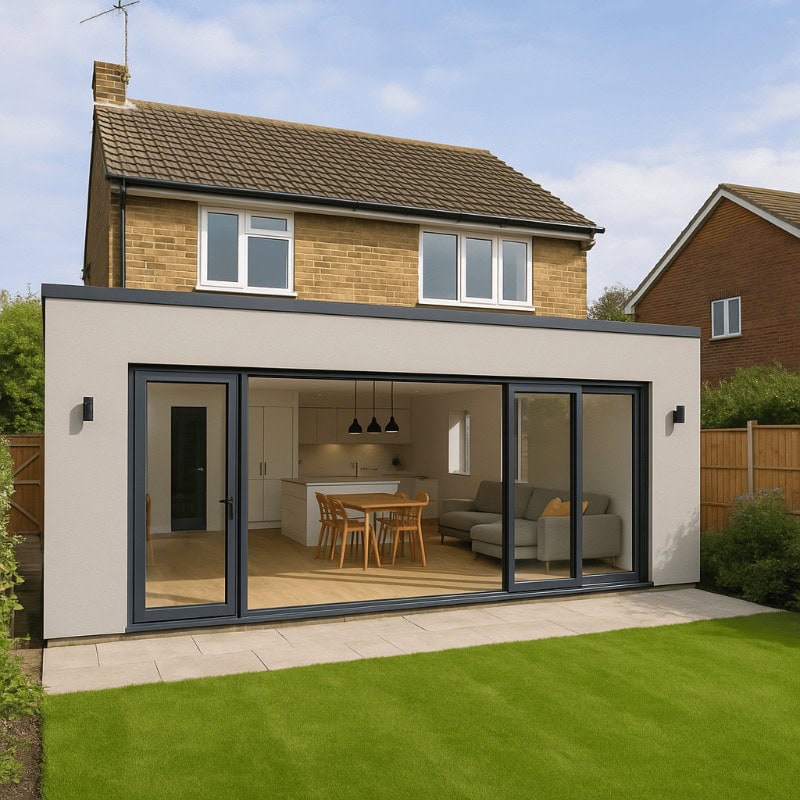
Choosing the right builder for your house extension is not about finding the lowest price; it is about finding the best value and the calmest path to a high-quality result. That happens when three elements align:
- A clear, buildable design
- A transparent, competent builder
- A homeowner who makes timely decisions.
Start with design. Engage an experienced architectural services provider to refine your brief, produce detailed drawings and a specification, and advise on planning and building regulations.
Use that information to invite three well-matched builders to price on a like-for-like basis. Visit their work, speak to their clients, verify insurances and trading history, and choose the one who communicates well, respects the drawings, and demonstrates the organisation to deliver.
At Blackrock Architecture, we have supported hundreds of homeowners across Kent to extend homes confidently. Our blend of design clarity, local knowledge and practical detailing helps builders price accurately and build efficiently, while our friendly, hands-on approach keeps stress to a minimum from feasibility to completion.
Transform your home, create space, and add value – without unnecessary drama. Don’t move, improve.